
How to Promote a Small Business in Kansas City
A practical plan to promote your small business in Kansas City: free listings, reviews, local partnerships, email, a test budget, and tracking what works.

The best way to promote a small business is to get the free basics right first: accurate listings, real reviews, a simple way for people to contact you, and a few local partnerships. Then test one paid channel, track where customers come from, and keep what works. This guide walks through that order for owners in the Kansas City metro, with specific moves for Kansas City, MO and KS, Overland Park, Liberty, Independence and the surrounding suburbs.
FindlocalkcHelp Kansas City Customers Find YouAdd your business to FindLocalKC’s directory so local residents can discover it by city and category across the Kansas City metro.Explore the local directoryKey Takeaways
- Start free: a claimed Google listing, local directory profiles, a basic website and customer reviews cost nothing but time, and the Library of Congress small business guide names them as free promotion strategies.
- Local promotion works best when it reaches people close enough to visit or hire you, so listings, neighborhood partnerships and events beat broad national advertising for most KC shops and service companies.
- Pay for advertising only after tracking is in place, and begin with two or three channels and a small test.
- Ask every new customer how they found you. That one question tells you more than most dashboards.
- Review results monthly and change one thing per channel at a time.
Table of Contents
- Start with what is free
- Get listed where Kansas City customers look
- Build reviews you can be proud of
- Use your neighbors: partnerships, events and referrals
- Social media: show up where your customers already are
- Email: the channel you own
- When to start paying for promotion
- Measure what is working
- Our perspective
- Put it into practice with FindLocalKC
- A 30-day plan
- FAQ
- Sources
Start with what is free
Most small businesses do not have a promotion problem so much as a findability problem. A neighbor searches for a plumber, a bakery or a pediatric dentist and sees whoever has the clearest, most complete, best-reviewed presence. Fixing that costs very little.
The Library of Congress lists these free strategies: creating a website, building a social media presence, fostering word of mouth, setting up a Google business page, and asking customers to review your products or services online. None of that needs an agency.
The free work is also your testing ground. Shopify’s advice is to combine several organic channels, watch which ones bring traffic and sales, and use that evidence to decide where paid money might belong. Free promotion still takes effort and experimentation, as Amazon Ads points out, so pick a few channels you can keep up rather than ten you will abandon.
A simple free checklist
- Claim and complete your Google listing, and correct anything inaccurate.
- Add your business to relevant local directories.
- Put your phone number, hours, service area and a contact form on your website.
- Ask happy customers for honest reviews.
- Post to one or two social channels on a schedule you can actually keep.
- Collect email addresses at the counter, at checkout or on your site.
The rest of this guide goes through each of these and then moves on to partnerships, events, paid tests and measurement.
Get listed where Kansas City customers look
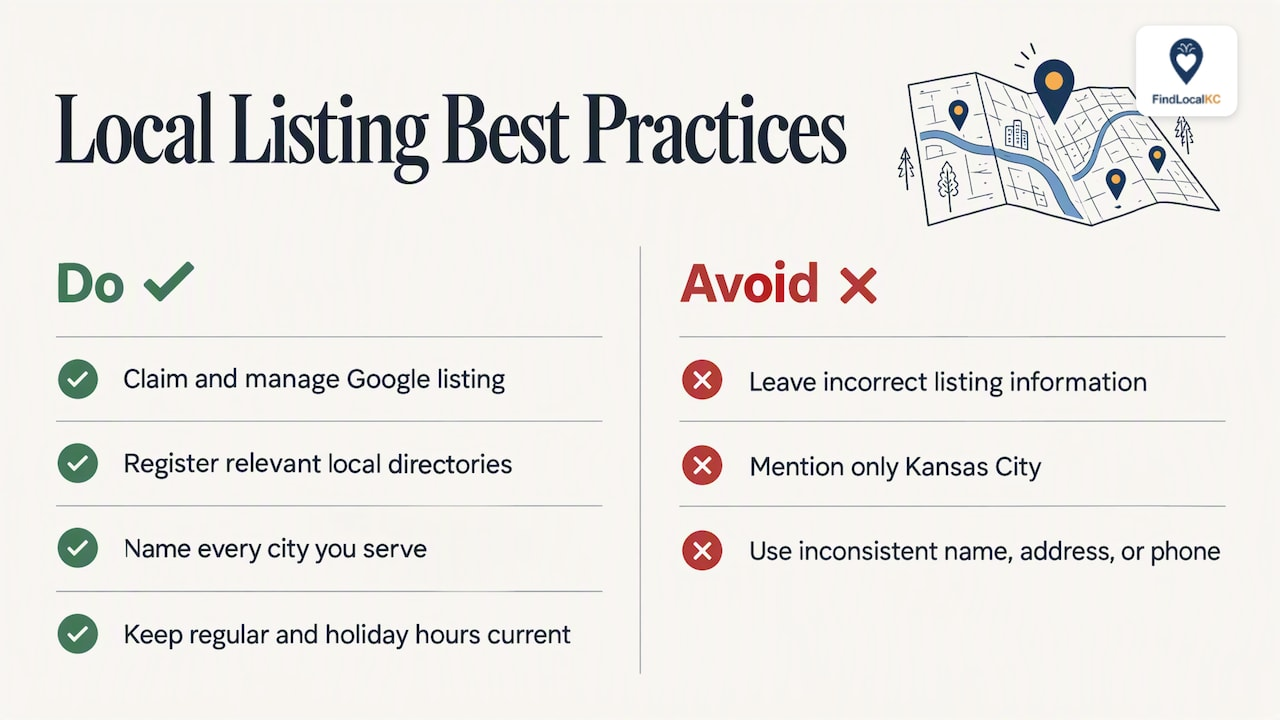
The U.S. Small Business Administration advises owners to claim and manage their Google listing, fix incorrect information, and note that Bing has a similar listing tool. It also recommends registering with relevant local business directories. The SBA defines a local business as one that gets most of its customers within a 75-mile radius, so the goal is reaching people near enough to walk in or book a visit.
In a metro that spans two states and dozens of municipalities, a customer in Overland Park may never see a business that only mentions “Kansas City” once. Be specific. Name the cities you serve, use the same business name, address and phone number everywhere, and keep hours current, including holiday hours.
A local directory does that work for you in a place built for the metro. FindLocalKC lists businesses across restaurants, home services, healthcare, fitness, beauty, auto services, retail, pets, entertainment, professional services and family and childcare. Residents can browse by city or category, such as Lee’s Summit, Mission or Gladstone, and then contact a business through the listing. For a deeper walk-through of listings, see our guide to free directory listings, and for search visibility specifically, our local SEO playbook for Kansas City.
Claim, then complete
A claimed listing signals that a real owner stands behind the information. Fill every field: services, hours, photos, website link and a short description written for customers, not for search engines. Photos of your storefront, your team and your finished work do more persuading than adjectives.
Build reviews you can be proud of
Reviews are promotion that other people do for you. The SBA suggests following up after a sale to welcome feedback and ask for a testimonial, with one firm rule: never offer anything in exchange for a positive review.
A few habits make asking easy:
- Ask at the moment of satisfaction: when the repair is finished, the cake is picked up, the class ends.
- Make it one step. Send a direct link by text or email, or put a QR code on the receipt.
- Reply to every review, the good and the bad, politely and briefly.
- Fix the problems that keep showing up. A pattern in complaints is free consulting.
If a negative review has already landed, our guide on improving your online reputation in Kansas City covers how to respond and recover.
Use your neighbors: partnerships, events and referrals
Online visibility gets you considered. Local relationships get you chosen. Search Engine Land’s local marketing guide says service quality, community involvement, referral partnerships and offline media can all reinforce local visibility and build trust signals beyond your website.
The SBA’s list of local tactics includes sponsoring relevant local events, cross-promoting with local businesses, starting a referral program, introducing yourself to local media, and hosting an experience event. Its example is a restaurant teaming up with a nearby movie theater on a dinner-and-movie offer, which works because the two businesses share an audience without competing.
Partnership ideas that fit Kansas City
Your business Natural partner Simple joint offer Restaurant or cafe Theater, brewery, venue near you Dinner-and-show pairing Gym or studio Physical therapist, juice bar Cross-referred first visit Home service company Realtor, home inspector Move-in maintenance checklist Pet groomer Veterinary clinic, trainer New-puppy welcome bundle Salon or spa Boutique, photographer Event-day beauty and style packageThese are starting points, not guarantees. The pattern is what matters: pick a business whose customers are your customers, and design an offer that is easy to explain in one sentence.
Events and workshops
A free class, a tasting, an open house or a table at a neighborhood market lets people experience what you do. Xero’s U.S. small business guide lists local events or workshops, classes, contests, community sponsorships and loyalty programs among its ideas. Keep any event small enough to run well, collect email addresses with permission, and photograph it for your listing and social pages.
Social media: show up where your customers already are
Amazon Ads recommends relevant profiles, frequent posting, interacting with customers, and using events, holidays or popular trends to lift engagement. For a Kansas City business, that translates naturally into local content:
- Behind-the-scenes shots of your work, your team and your products.
- Seasonal posts tied to holidays, school calendars, football Sundays and the weather.
- Answers to the questions customers ask most.
- Tagged locations and neighborhood names, so nearby people find you.
- Reposts of customer photos, with permission.
Pick the one or two platforms where your customers spend time. A landscaper might favor neighborhood-focused channels and Facebook, while a boutique may do better with visual platforms. Consistency beats volume: three solid posts a week for a year outperform a daily blitz that fades in March.
Email: the channel you own
A newsletter reaches people who already said yes. Chase suggests useful advice, behind-the-scenes content, offers and announcements, and recommends collecting subscribers through social media, your website or the point of sale, then keeping the list current and segmented.
That last part matters. A segmented list lets a salon send a color-appointment reminder to color clients and a holiday gift note to everyone else. It also protects your reputation with inbox providers, which is why basics like email deliverability deserve a look before you send to a big list.
A workable rhythm for a small business is one email a month with one clear action: book, visit, call or reply.
When to start paying for promotion
Pay after the free foundation and tracking exist. Forbes recommends starting with two or three channels that match how your customers buy, tracking leads through to sales, and comparing what it costs to win a customer with what that customer is worth over time. Budget then moves toward the channels producing profitable customers.
Keep the first test small. The SBA suggests a modest $100 test campaign when targeting local users on Facebook, rather than a large initial commitment.
A worked example
Say a Liberty hair salon spends $100 on a local test and books four new clients from it. If you can trace those four clients, you know the test cost $25 per new client. If an average client books six visits a year, you can judge whether $25 is a bargain or too much. Without the tracing, the same $100 is just a guess. The numbers here are illustrative, not a benchmark.
Paid placement in a local directory
The advantage of directory placement is that the audience is already looking to hire or visit someone nearby. On FindLocalKC, basic inclusion is free. Paid upgrades are for owners who want more visibility: Featured is $29 per month and Premium Spotlight is $79 per month, and listings are sorted with premium placement first. Treat it like any other test: try it, track the contacts it generates, and decide with data.
Measure what is working
The worst promotion plan is one you cannot evaluate. Microsoft recommends tracking traffic, engagement, conversions and cost with free tools such as Google Analytics, Search Console, email and social dashboards, and Google Business Profile Insights. Review monthly and make one deliberate change per channel per cycle, so you know what caused a gain or a drop.
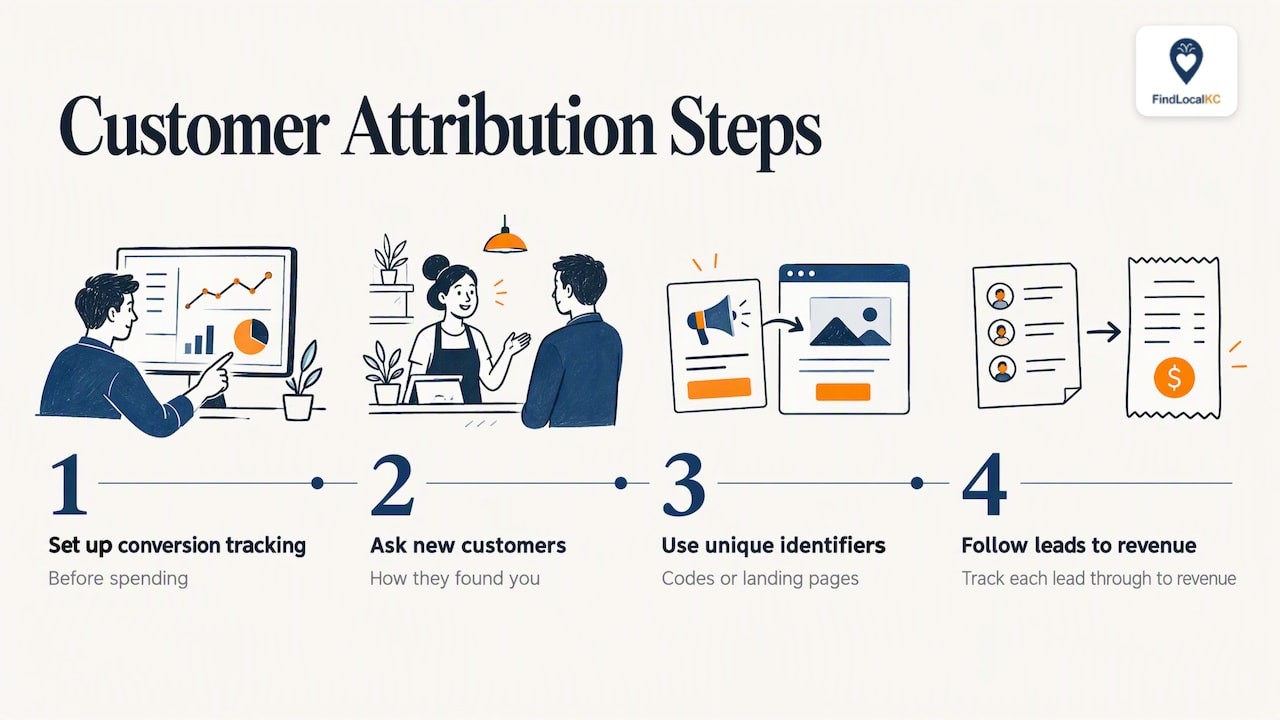
Forbes adds that channels should be judged by the cost to win a customer and the revenue that customer brings, not by clicks, likes or impressions alone. Its practical steps: set up conversion tracking before spending, ask each new customer how they found you, give channels unique codes or landing pages, and follow leads through to revenue.
WordStream recommends UTM parameters on campaign links and a “how did you hear about us?” field on forms or in phone scripts. Each month, cut the weakest channel and put more effort into the strongest while keeping the mix manageable. If you want a framework for tying promotion to returns, these ROI measurement guides are a good place to look.
A one-page monthly scorecard
Channel Contacts New customers Cost Cost per customer Google listing Directory listing Email Social Referrals and partnersFill it in on the same day each month. After three months you will see which rows deserve more of your time.
Our perspective
We run a Kansas City directory, so we see the same pattern again and again: businesses that do well are not always the biggest or the best funded. They are the ones whose information is accurate, whose reviews are real, and who make it easy to get in touch.
That is why we built free listings and no-cost claim and verification. Every business should be findable, and a verified owner makes a listing more trustworthy for the resident reading it. We would rather you start free, learn which customers respond, and upgrade only if the contacts justify it.
We also believe a metro as spread out as Kansas City needs city and category pages rather than one giant list. A family in Gladstone looking for childcare and a driver in Mission looking for an auto shop are searching differently, and your listing should meet them where they are.
— Zach
Put it into practice with FindLocalKC
If you want one place to begin, claim your business on FindLocalKC. Basic listings are free, and you can see how the directory works before you commit to anything.
Not sure what is holding your visibility back? Run the free website and SEO audit for a clear picture of where you stand. When you are ready for more exposure and lead contact forms, compare the Free, Featured and Premium Spotlight plans on the pricing page. If you need hands-on help with campaigns, you can also browse local marketing and advertising agencies in Kansas City, MO.
Residents reading this: every listing is a chance to support a neighbor. Browse by city or category and contact a business straight from its listing.
A 30-day plan
Week 1: Claim and complete your Google and directory listings. Fix your name, address and phone number everywhere.
Week 2: Set up tracking, add a contact form to your site, and add a “how did you hear about us?” question to every intake.
Week 3: Ask your ten most recent happy customers for a review. Contact one neighboring business about a joint offer.
Week 4: Send your first email, post consistently, and fill in your scorecard. Choose one paid test, sized so you can afford to lose it.
FAQ
Can I promote my small business for free?
Yes. Free options include a website, social media, word of mouth, a Google business page and customer reviews, according to the Library of Congress. Free does not mean effortless, so choose a few channels and track results.
What is the best way to promote a local business?
Start where nearby customers search: your Google listing and local directories. Then add reviews, partnerships with complementary businesses, local events and a simple email list, as the SBA outlines.
How much should I spend on advertising?
Start small and test. The SBA’s example is a $100 local Facebook test, and Forbes advises starting with two or three channels. Increase spending only where a channel brings customers for less than they are worth.
How do I know if my promotion is working?
Track contacts and new customers by channel, ask every customer how they found you, and review the numbers monthly. Change one thing at a time so you can tell what made the difference.
Sources
- Promotion - Small Business Hub, Library of Congress
- 10 Local Marketing Strategies That Work, U.S. Small Business Administration
- Local Marketing Guide, Search Engine Land
- Free Advertising: 11 Ideas for Small Businesses, Shopify
- 8 Free and Low-Budget Advertising Ideas, Amazon Ads
- How to Promote Your Business Locally, Chase for Business
- Small business marketing guide, Xero
- The Most Effective Ways To Advertise Your Small Business, Forbes
- A Guide to Small Business Marketing Strategy, Microsoft
- How to Promote Your Business No Matter Your Budget, WordStream
- ROI measurement guides
- Email deliverability guide